Tips
Why Do Decking Boards Crack? 6 Common Causes and How to Avoid Them
Decking boards crack when uneven wetting and drying create stresses within the wood. Installation mistakes, trapped moisture and unsuitable maintenance can increase the risk. However, a fine surface crack and a deep split around a screw are different problems and need different responses.
Thermally modified decking boards swell and shrink less, but they can still split. Thermal modification improves dimensional stability, although it can also make wood more brittle. Correct installation therefore matters for thermally modified pine, spruce and ash, rather than relying on the choice of species alone.
Uneven drying
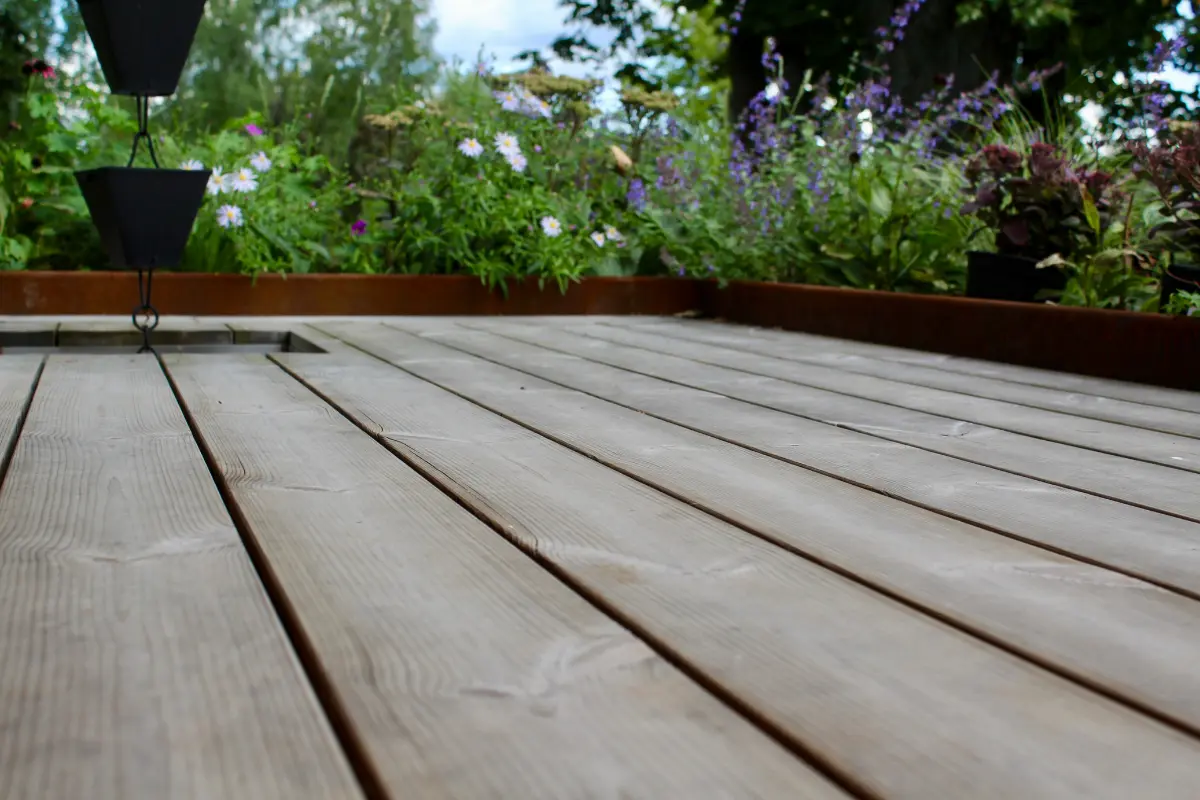
After rain, the surface of a board dries in the sun while deeper layers remain damp. Uneven shrinkage creates stresses that can cause cracks along the grain. Prevention starts before installation: store boards on level supports, raised off the ground and protected from rain and direct sunlight. Covers must allow air to circulate. Do not leave wet boards tightly wrapped, as trapped moisture prevents them from drying evenly.
Moisture trapped beneath the deck
Without ventilation underneath, the upper and lower faces of a board dry unevenly. Standing water and gaps blocked by leaves make matters worse. Provide drainage, airflow beneath the deck and suitable gaps between boards and alongside walls. Enclosing the sides without ventilation openings can trap moisture even when board spacing is correct. Gap sizes should follow the requirements for the particular boards and fastening system, not a universal rule.
Incorrect fastening
Screws positioned too close to board ends or overtightened can start a split. Where the installation instructions require it, drill pilot holes and countersink for the screw heads. This is particularly relevant for thermally modified ash. Use stainless steel fasteners compatible with the system, without driving the heads too deeply into the wood. Check the manufacturer’s guidance for drill diameter and distances from board edges and ends.
Unprotected board ends
Cracks can begin at board ends, so caring for the visible surface alone may not be enough. Protect cut ends with an end grain sealer recommended for the product to limit moisture entry. Standard decking oil does not necessarily replace a dedicated sealer. Treating the ends before installation makes them easier to reach. Any new cuts made during fitting also need attention according to the manufacturer’s guidance.
Excessive spacing between supports
When supports are too far apart, boards can flex more and suffer mechanical damage. This differs from fine surface cracks caused by drying. Support spacing must match the board thickness, profile and expected load. Hidden fastening clips must also suit the profile. Inspect board ends and grooves before installation. Do not fit a deeply split board expecting the screws to stop the split from spreading.
Unsuitable cleaning and surface care
A powerful pressure washer jet can damage the wood surface. A brush, a suitable wood cleaner and a gentle flow of water are better choices. Oil formulated for thermally modified wood can help reduce surface cracking, while a pigmented product also slows colour changes caused by UV exposure. However, oiling cannot guarantee that boards will never crack or compensate for installation mistakes. Apply oil to clean, dry wood and renew it according to the surface condition and product instructions.
When does a crack need closer attention?
Fine surface cracks can be a natural response to outdoor exposure. However, a deep split near a fixing, a loose board or splinters coming away need attention. Ask an installer to assess the depth of the damage, the fastenings and the supports. The board may need replacing, and the underlying cause should be addressed. Applying oil alone will not solve the problem.
Need help choosing decking boards and reducing the risk of cracking?
Contact ESSPO Wood. We can help you choose thermally modified wood and a decking profile, and discuss installation and maintenance options suited to your deck’s conditions.